ATMA SEVA – First impressions of Wiang Haeng

Welcome Maria

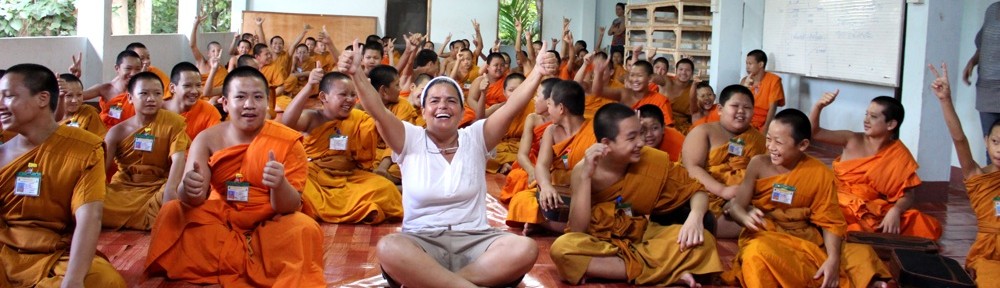
Me (center) with two other ATMA SEVA on-site interns

When I was first told that I would be spending the next four months living in Wiang Hang, I wasn’t quite sure what to expect. I studied the tiny speck on the map and wondered what life would be like there, what stories the people had to tell, and what new adventures lay ahead. The past two weeks here have indeed been an adventure with no two days the same. But this is exactly the type of adventure I was hoping for. After living in Bangkok for 3 months, I was eager to move to a more rural area where I would have an opportunity to learn more about Thai culture and challenge myself to learn Thai.

The area I am in is actually comprised of multiple townships, each with its own distinct culture, language, and story to tell. Within a 15 minute car ride, you are able to visit a Karen village, a refugee camp that has an expansive solar-power project, and a village with Chinese roots (complete with traditional dress and red Chinese lanterns hanging from every home). The majority of the people in the region, however, are from the Shan State in Myanmar. In spite of the diversity in the area, the one aspect that is universal is the importance that Buddhism plays in each of their cultures. Every temple and pagoda is different – each one reflecting the stories and culture of its members.

novices construction Wiang Haeng

Novices helping with the construction

I am currently living in Pleekwiwek Dhamma Center, along with thirty novice monks and three monks. Pleekwiwek serves multiple functions: it is a dhamma center and meditation retreat, the home and training center for the novices, a community center, and a model for self-sufficiency. The founder of the center and current director, Dr. Phra Ajarn Thanee, received a master’s degree in agriculture, a fact that very much shapes the way the center is run. The novices grow a majority of the vegetables and rice they eat right here at the center. In addition to learning about farming, they learn how to make bricks out of mud and cement and have built a number of the cabins on the grounds. Novices learn to value the homes they have built for themselves, the food they have grown for themselves, and even the cotton they have grown to make the robes they wear. Therefore, the boys who have lived here have not only had the opportunity to attend school and learn about Buddhism, but also learn valuable life skills that they can apply to future life endeavors.

Pleekikweewak

Shot from Pleekwiwek Dhamma Center

In spite of my efforts, I still struggle to pronounce the name of the Center correctly (at least, the locals don’t seem to know what I’m saying), however, as soon as I say that I am teaching at Wat Kong Lom and am working with Dr. Thanee, everyone kindly reminds me of the correct pronunciation: Pli-wih-wehk. It’s clear from their reactions that Dr. Thanee and the work he does is an integral part of the community. This is also evidenced from the number of training camps that have taken place here in the past few weeks.  The trip here started with an English camp which was followed by a weekend retreat with over one hundred students from the local government school learning about Buddhism and sufficiency economics, a few days later we had a flock of women working frantically to prepare decorations for blessing a new construction site, then we received a group of soldiers who helped plant numerous trees on the grounds, and then we hosted a large retreat for all of the students from Wat Kong Lom.

I am excited to be here and see all of the activity taking place around me. I never would have expected that that little dot on the map could be so full of life and yet so peaceful.

I have been working in the field of community organizing and event planning for many years, but I decided to come to Thailand to learn more about how community development takes place in developing nations. Pleekwiwek has been a great experience in teaching me more about sufficiency economics and the way that a community that is so diverse can come together as neighbors to help one another.  In the short time that I have been here I have learned more about Thai culture, language, and Buddhism than I have in the previous 3 months living in Thailand!

Buddha view Wiang Haeng

View from Wat overlooking Wiang Haeng

I am eager to continue learning – learning about northern Thai culture and all of the diverse groups in the region. I have already learned three new ways of saying “hello,” I’ve been anointed with a Thai name, and have heard numerous folklore stories from the region. I am also excited to begin teaching English. The people in the region and the novices I am working with are just as eager to learn about me, my culture and my language as I begin to teach at Wat Kong Lom temple school.

Don’t forget to Like ATMA SEVA on Facebook to follow along for all the adventures!

Maria

maria@atmaseva.org

www.atmaseva.org

A visit to Wat Don Chan

The ATMA SEVA team recently took a trip to Wat Don Chan, a temple and orphanage located in Chiang Mai, with friend of the program Stuart Skversky.  Stu has been working with the temple and children since 2009 through his organization, Stu and the Kids.

The goal of this post is to share the story of Wat Don Chan, the work that Stu does, and ways for people to get involved.

Statues at Wat Don Chan

Statues at Wat Don Chan

Wat Don Chan is a Buddhist temple which has an adjoining school and University with living accommodations for the students on the premise.  Currently, roughly 650 children live at Wat Don Chan, way more than the facilities are designed to hold. Despite the crowd now, up to 900 kids lived here at one time! Of the current 650 living here, 450 of these children are school aged and attending the government school, ages five or six to sixteen.  All of the children living here come from various hill-tribes and many are orphans. They all come here with the hope to get a better education.  It is free of charge for the children to come and live here and study, with the support of the Thai government, the supporters of the Wat, and various Foundations.  Even with the mentioned support and funding, the living quarters where the children stay are sub par, the daily food given is not enough, and educational materials are scarce.  It is also worth noting that the school is at the discretion of the abbot.  Day to day activities are run by the teachers, but ultimately final decisions are up to the abbot.

School at Wat Don Chan

School at Wat Don Chan

There are only four women on location to watch over and take care of the children.  Because of this, students at Wat Don Chan have a way of “growing up fast,” in the words of Stu.  It comes down to the older children taking care and looking after the younger children.  From a Western perspective, this is hard to grasp, being completely on your own at the age of 7 or 8.  It is also different when you visit and see the set up that the gravity of the situation fully settles in.

Children delivering dinner to all of the students

Children delivering dinner to all of the students

Wat Don Chan is a well-known temple and famous because of the abbot, who is said to be clairvoyant.  Many Thais travel from all over to visit and speak with the abbot with the hope to gain knew knowledge about their life or futures.

Buddha statue at Wat Don Chan

Buddha statue at Wat Don Chan

The Wat is also home to thirty monks, many who are originally from Burma.  Despite the overcrowding and lack of funds/resources, Wat Don Chan is home to many bright and motivated young students. Stu has been working tirelessly with this community and fundraising to support the further education for graduates of the school.  There is a technical college associated with the Wat where university teachers volunteer their time to teach high school graduates, but it is difficult for graduates to attend four-year universities. Money is often an issue, so the funds that Stu is able to raise go directly towards these students’ university fees.

Below are several projects that Stu is actively involved with and fundraising for;

  • Paying for multiple students University tuition.
  • Buying/finding new or used computers for the students.
  • Teaching English and cooking classes on a weekly basis.
  • Running English camps periodically through the year.
  • Helping hill-tribe or Burmese students obtain a Thai ID card which enables them to study at the University level
  • Collecting donations of clothes, school supplies, and gym equipment.
Wat Don Chan group picture

R-L; Michael, Katherine, Dave, Dan, Stu

To read more about Wat Don Chan, Stu’s work, and how you can contribute, visit his website at www.stuandthekids.org.  ATMA SEVA has been working with Stu since 2009 on various projects and look forward to many more collaborations!

ATMA SEVA team

info@atmaseva.org

www.atmaseva.org

Where Are They Now? – Alison

In our latest installment in “Where are they now?” we check in with Alison who volunteered for one month with our Wat Doi Saket project in October of 2011.  Read below to find out about her time in Thailand and her reflections about her time with ATMA SEVA!

atmaseva1) How did you get connected to ATMA SEVA? Why did you choose to volunteer with the Wat Doi Saket project?

Back in the summer of 2011, I decided to take a sabbatical from work and travel/volunteer abroad. I sent an email to friends and family asking for any suggestions for volunteer options or recommendations for specific programs. My friend Chris Poppe responded that his cousin was running a volunteer program in Thailand. After reading some scary reviews of various programs, the idea of having a contact I could trust was very appealing. Coincidentally, I was invited to a wedding in India around the time that I planned to go abroad. Thailand and ATMA SEVA quickly became the best option.

 2) How did you like teaching English at a Thai government school?

Teaching at the school was absolutely amazing, although the road to amazing is not always a straight one. Initially I found the teaching to be incredibly stressful. I didn’t feel I was bringing enough value to the children and it made me feel like I was failing. Once I learned to relax and just enjoy being with the kids, everything changed.

OLYMPUS DIGITAL CAMERA

Me teaching at the government school!

3) What were some of the challenges you faced?

I felt very isolated in the guest house I initially chose, classes were canceled often, and the teacher didn’t always show.

4) What is the most memorable moment from your trip?

So many wonderful places and people were a part of my time in Thailand – Wat Doi Saket, the kids at Ba Mai Dang School, the Australian missionary Peter (also known as the most positive person I’ve ever met). I’m not sure what would be the most memorable, but I can say that the most “spectacular” moment of my trip was watching my lantern fly up into the sky during the Loi Krathong festival!

Loi Krathong festival!!

5) Where are you now and what are you doing currently?

I’m back living and working in New York City as a Director on the regulatory consulting team for Kinetic Partners, an asset management consultancy.

6) Any travel plans on the horizon or other places you’d like to visit?

I’m heading to New Orleans next week for some jazz and a sazerac, but the next big adventure on the horizon is South Africa.

7) What did you learn from your time in Thailand and volunteering with ATMA SEVA?

Although research and planning is usually a good idea, sometimes you just need to let a place wash over you.

8) What advice would you give to someone who is looking to volunteer overseas?

Don’t be afraid to ask detailed questions about every aspect of the trip. The more information you have about your day to day activities and down time, the better. I was lucky with ATMA SEVA, but if you do not have a connection to the program, I would also recommend asking for testimonials from prior volunteers and the ability to reach out to them if desired.

DSCN1076_2

I taught briefly at Wat Doi Saket and pictured is me with some my students!

info@atmaseva.org

www.atmaseva.org

Lawa Village – Teamwork in Pa Pae

Hello folks,

My name is Dan Yachnin and I feel very lucky to have been able to spend the past month teaching English in the Lawa village of Papae with ATMA SEVA. I had just finished a year of teaching English in South Korea and wanted to make a few stops on my odyssey back to my Canadian home. This stop has been relaxing, beautiful, and inspiring.

Image

Farewell dinner in Pa Pae. From left to right: Pee Bit (Nid’s sister-in-law), Nid, me, Nid’s mother

I had never visited a community this small and this remote in my life and never imagined that (in a small way) I would ever become a part of one. I tried to picture the village before coming here and tried to imagine what would make it roll. I figured that for the community to have any kind of success and survival it would require the people to work together.  I could not have anticipated how right I was! The village works together as a team in which everybody seems to do their part and everybody seems to show caring and acceptance of one another.

As a teacher, the first obvious example of teamwork naturally appeared in the classroom. I had never really taught this level of ESL students and I admit that some of the work I gave and some of the questions I asked were much too hard for many of the students. Nevertheless, the ones who understood were always keen to help out the ones that did not and were always kind about it. I guess that’s not so surprising. What I found amazing was how nicely the students played what should have been competitive games! Games as simple as memory matching (that were supposed to lead to individual success) became group efforts as students looked around the room for guidance on which card to flip next. This was a sharp contrast to the experience I had in S. Korea where choosing to do a quick, mildly competitive review game before a test risked the onset of tears!

Next was football (or soccer to N. Americans). In the late afternoons when the weather cooled down a bit, the older boys always came out to play football. Once again, there were never any tears and never any pushing. Everyone was happy to play together and everybody seemed welcome to join (though I don’t think I ever saw any girls playing… they are, however, supposedly amazing at volleyball). Where were they getting these wonderful values? Why were they so much more respectful of one another than the students and athletes back home?

Let’s move up the ladder a little further and check out what happened on Songkran. Songkran, discussed in more detail by Katherine here, celebrates the lunar New Year and is of great importance religiously to the Buddhists in Thailand and socially to pretty much everyone.  Many people came back to Pa Pae to spend the holiday with their families and with each other. The younger adults got together to build dams in the river and prepare for a big water fight. The older adults got together to plan a route to pay respects to the elders of different households, which involved very respectfully pouring a small amount of water on each elder. Both groups shared the duty of ensuring plenty of village whiskey to last the day! It was a great holiday and only because everybody was pushing in the same direction.

Image

Villagers working together to build a dam during Songkran

Finally, I’d like to talk about the funeral that I witnessed during my last week. It was a 3-day event to honor the passing of one of the village’s elders and it was a very strong demonstration of how people can come together. Everybody stopped what they were doing for three days and came to pay respects in many forms including candle lighting, chanting, dancing, eating together and staying up every night until 6am so that the body was never alone. It was a beautiful mixture of mourning and celebration. There were countless jobs to go around and everybody seemed to know what to do. People also contributed money to pay for an animal to be sacrificed and eaten for the occasion. A pig would be a small honor whereas a buffalo would be much better. When I woke up, I saw a man with a machete walking near my house. He saw me and signaled for me to come and to bring my camera. I followed him to the site of the recently killed buffalo where about 20 people worked away with machetes to harvest the body. After I had brought the horns over to the house of mourning (about all I’m good for) I saw that there was also a pig and a whole other buffalo that had been purchased for the funeral. This meant more donations and more work that morning to get everything ready for the village of only about 200 people.  Later that day people from other villages came to join in the ceremonies and showed me that there was an extended family to the already giant family of Pa Pae!

Image

A group of Pa Pae men preparing the buffalo meat for cooking during the 3-day funeral event

I cannot thank this village enough for the hospitality it has shown me and the ways that it has inspired me. At a time where I was checking internet updates on war threats from North Korea and explosions in the Boston Marathon, Pa Pae reminded me what it means to work together and solve problems together. I won’t forget that!

Thank you for a great month!

Dan

info@atmaseva.org

www.atmaseva.org

Photography Corner – English Camp in Wiang Haeng 2013

On May 4th, 5th, and 6th the ATMA SEVA team assisted with an English camp in Wiang Haeng, Thailand.  To read all about the English camp, how it was structured, and our general reactions/advice, please click here.

Below are photos from the three days of activities, games, and learning!  Thanks again to Yao and Lawrence who organized and led the camp.  Enjoy the photos!

Photos by: David Poppe

david@atmaseva.org

www.atmaseva.org

Teaching Abroad – English Camp in Wiang Haeng!

Last weekend, the ATMA SEVA team took a trip up north to Wiang Hang to participate in a 3-day English camp for novice monks and set up our newest on-site intern Maria. The camp was held at Plekwiwek Dharma Center, a Buddhist center attached to Wat Kong Lom, that leads meditation retreats, hosts various camps and seminars, and teaches novice monks to grow and cook their own food, design and build houses and become leaders within their communities. The center is in a beautiful location with outstanding mountain views.

wiang haeng good view blog pic

View of Wiang Haeng from local temple.

The camp was organized and led by friends of ATMA SEVA, Yao and Lawrence, who had run a similar camp with the same students back in March. The theme of the English camp was “Community Helpers” and we played games, sang songs, and lead group activities all focused on people in the community and their job responsibilities. Here is quick overview of our schedule for the first 2 days:

  • 8:00 – 8:30 Orientation/ Breakfast (Choose names, make tags, name games and general introductions to camp. Second and third day made waffles!)
  • 8:30-10:15 Review of theme & new vocabulary (lots of singing and group games)
  • 10: 15 – 12:00 Cooking & lunch (Remember the monks cannot eat after 12!)
  • 12:00 – 12:30 Break
  • 12:30 – 2:30 Station Activities (Introduction to community helpers, job responsibilities and where they work, drawing, matching games and “salad bowl” -see games list below)
  • 2:30 – 3:00 Break                                                       
  • 3:00 – 4:00 Writing activities (Crossword puzzles, what do you want to be and why?)
  • 4:00 – 6:00 Free time & dinner for the teachers           
  • 6:00 – 8:00 Games! (Not all related to community helpers but fun and engaging games)

Since the camp stretched over a few days, versus one day or an afternoon, we had a variety of different activities to keep the novices engaged while still practicing the new vocabulary and keep with the community helpers theme.  Yao took classic nursery rhymes and kids songs but changed the lyrics to fit the theme, had flashcards with the helpers and their job responsibilities, and enforced the vocabulary with pictures and acting games. Even when some vocabulary and phrases felt repetitive, it was the best way for the novices to understand and retain the “curriculum” of the camp.

In addition to helping with the morning and afternoon activities, ATMA SEVA was in charge of planning two 2-hour blocks of games in the evening for the 40 novices. Below are some of our favorite games that worked well with the novices and can be played with larger groups of school kids as well.

Recommended Games/Activities:

novices cooking in wiang haeng

Novices preparing spaghetti sauce.

Cooking – Cooking is a great way to engage all your students, teach about food and foreign dishes, hear new vocabulary, and for the students to learn new skills. Make sure to plan menus well ahead of time to prepare shopping trips, and enough food for the whole time.  During our three days we made: waffles, scrambled eggs, toast, pork burgers, french fries, salad, fried chicken and spaghetti!

Salad Bowl  - Students sit in chairs in a circle, with one person standing in the middle. Make sure there is one chair less than the number of students, just like musical chairs. Each student has a slip of paper with their “group” name written on it that they don’t show others. For example, for community helpers the groups were : doctor, fireman, policeman, etc. The student in the middle calls out a group and everybody in the group has to get up and find a new seat before the person in the middle gets one first. The last student left standing is now it and shouts out a new “group” of his/her choice. Great way to practice vocabulary and we found the novices playing the game themselves well after camp was over!

salad bowl game

The salad bowl game in action!

Human Knot – Students stand in a circle and grab hands with someone across from them (but not their neighbors!) When all the students have joined hands, they must work together to untangle themselves and become a circle again without letting go of their hands! There is no too much English involved but the novices really enjoyed the challenge and cheered when they untwisted themselves!

Hokey Pokey - A classic but it works! The novices loved seeing the teachers be silly and getting a chance to be silly themselves. Plus it is a great way to review body parts. (Hint: We reviewed body parts before the song by using a human model and having the novices identify and stick labels to match “arm”,”leg”.. etc.)

Who’s the Best - Split the students up into even teams (and equal mixes of age and English ability) and let each team pick a name. The instructors create a list of “challenges” for the students to do, and each group chooses one person to come up and do the challenge and the “judges” award points to each team. We even added group challenges for teams to win points together. The team with the most points at the end of the game wins. Examples of challenges include: count backwards from 20 the fastest, most pushups, best animal noise, best whistler, and best Gangnam style! For team challenges we gave the teams a word scramble, and to list all the ASEAN countries. The novices had fun with the friendly competition and were excited to play against their friends.  You can incorporate any challenges to fit your theme and can have a mix between English related challenges as well as fun and goofy ones.

No Bananas in the Sky – This activity was added by an ATMA SEVA volunteer with experience teaching at summer camps and was a fun song to sing with the novices. We taught the lyrics: “There are no bananas in the sky, in the sky, there are no bananas in the sky. There’s a sun and a moon and coconut cream pie, but there are no bananas in the sky, in the sky.” Each word has an action attached to it and after teaching both the song and actions, you remove a word each time and just do the action until you are not singing and then add the words back in one at a time. The novices picked up the song right away and all the teachers joined in too! Definitely a great addition to the evening games.

no banana song

Teaching the song!

Advice for planning an English camp: 

  • Be sure to prepare materials ahead of time and bring extra pens, pencils and paper. Also bringing music is a good idea for games, sing-a-longs, and to play during down time or liven up an activity.
  • If cooking food with the students, prepare utensils and food stations ahead of time and let each teacher/volunteer know their roles. The novices are pretty self sufficient but still needed guidance and supervision.
  • Have a back up plan! If the power goes out, you run out of materials, or what you planned for 30 minutes only takes 10, be ready to have some simple backup games and/or group activities. Stick to your schedule as much as possible to stay organized but be flexible to adjust games, activities and timing based on students understanding of the games, content and/or unexpected challenges – especially in Thailand!
  • Remember to take lots of small breaks for the students to relax a bit and the teachers to regroup and go over activities for the day.
  • Tailor your games and activities to be appropriate for the age and ability of your students and keep rules in mind when working with novice monks (can’t eat after 12, no “touching”, games not too physical, etc.)

Overall we had a great experience and are excited to go back for another camp very soon! A big thank you to Yao and Lawrence for organizing the camp and to the monks and novices of Wiang Haeng!

Stay tuned for the photography corner about this camp and if you have any questions or comments about planning games, setting a schedule, or anything else just leave a comment below!

Katherine Devine

katherine@atmaseva.org

www.atmaseva.org

Teaching Abroad – Introduction from Marcia

The ATMA SEVA team has decided to include a NEW section on our blog, ‘Teaching Abroad’, which will include stories of teaching experiences from ESL/EFL Certified Teachers, present, past and future ATMA SEVA volunteers’ and interns’ as well as;

  • Suggestions to make teaching fun and interesting
  • Tips for class management
  • ESL Games, Ideas and Activities that can or have worked in the classroom
  • Funny and unique classroom experiences
  • Online resources
  • English camp ideas and reflections
  • Interesting websites about teaching
  • And so much more!

Without further ado, this will be our first entry and it is my turn:

DSC06768

Marcia with some of her students

My name is Marcia and I am an ESL/EFL Certified Teacher whose first language is not English, but Spanish; however, the English language somehow feels more natural to me –I read and write in English more than I do in Spanish, to the dismay of many of my Spanish speaking friends. Given that English is not my first language, I most likely make mistakes and might even have an accent here and there, but having had to personally learn a second language has helped me immensely to understand second language learners; I try to do my best and I strive to help my students communicate in English and to not be afraid of making written or oral mistakes, which are part of the fun of learning.

What is it like when I walk into a classroom? What is my most important goal?

When I walk into a classroom, I feel transformed, happy, motivated….almost like a brand new battery:  fully charged!….and yes, sometimes I also feel tired and frustrated but that’s part of the deal. I think everyone should, at least once in their lives, give being in front of a class a try. The first thing I do is try to get all the students’ names and try to memorize them all right in the first hour….this did not work so well in Thailand, all of their names were so new to me that it was impossible. Name tags helped…

My most important goals for my students:

1) I want the students to feel comfortable enough to make mistakes, to be foolish, to SPEAK; so, I make a fool of myself first, acting, signaling, drawing, even trying to speak a little of their native language……..etc.  This sounds odd but in order to learn a language one must understand that the pronunciation and the correct usage is almost impossible right away. We weren’t able to speak our own mother tongue without making mistakes in the beginning. It is not like we have a chip where we can just upload information, like in the Matrix movies. As we get older we become more self conscious and it hinders our ability to learn a new way of communication. The acting and the allowing myself to be foolish helps them see that it is OK.  It is OK to make mistakes, to pronounce incorrectly or to have an accent when using the new language…it is part of the deal.

In the beginning, usually students will laugh at one another; this laughter, most likely, comes from a place of self protection and fear. I try to help them relax and see that it is funny but not good to make fun of others; you must be attentive to the vocal tone and/or body language to notice the difference……..once they are able to let this go, and learn to laugh with each other we can have lots of fun during class without making others feel uncomfortable. That is my favorite part. One however, must be very careful because having fun does not mean not working hard, and this is where we monitor the feel of the situation, by settling students down….speaking in a whisper….or not speaking and just looking at them…..or acting something silently while focusing on the students who are paying attention to you…..little by little they will start to quiet down….you should not try to ‘calm them down’ by shouting or yelling….I think this makes it worse.

novices having fun at English camp

Novice monks having fun learning English

2) I like to engage the students into PARTICIPATING, I joke, interact and laugh with them. I like to be physical, in a loving way, it helps me feel closer to my students. However, these particular activities were a bit challenging while teaching Buddhist novice monks. A Buddhist monk or novice may not be ‘touched’ by women; I could neither ‘high-five’ them nor tap them on the shoulder nor touch their heads….no physical contact whatsoever. It was very hard in the beginning, but after a while I was able to feel comfortable with those limitations and was able to enjoy myself in the classroom.

My most important goals as a Teacher Trainer:

1) To help teachers not to be intimidated by the students; they are not there ‘to get you’ like the boogeyman; remember what it was like being a student and behaving mischievously?  It was harmless, however your attitude is everything.

2) To help teachers realize that they are just as human as their students and the title ‘teacher’ does not include ‘perfection’. We are humans and we cannot KNOW everything; it is vital to say “I do not know” followed by “I will find out and let you know”. Students can also teach us many things if we let them.

Past experiences & advice

Students appreciate honesty and when that happens they are more likely to engage and participate. We are there to help out, to facilitate. The students will do the rest, and when they are engaged, they will go beyond the finish line, just for the fun of it.

I remember when I started teaching “Advanced English” to English speakers at a high-school in Cabo; I felt intimidated, for the first time in my life I experienced fear of teaching, I had no idea what that was until that time…. and I am thankful for it.

As I walked in the first time, two of the girls, decided to switch their names. I didn’t see it right away but towards the middle of the class I realized it; their attitude was not the ‘fun’ one but the ‘let’s get her’ kind of mean…….but I was not about to follow that, better yet I let it go on for the whole class and in the following one I told them it was a good one and they had definitely gotten me!  They had had their fun teasing me, and I had enjoyed their joke; but it was time to start responding to their own name.

We had a boring “Literature” book and I had to read many parts of that in front of the students and boy was it hard!!…  I made colossal pronunciation mistakes, to which the students laughed. So, I decided to level with them and openly admitted that English was not my FIRST language but my SECOND and I was very likely to make many mistakes with all of those old English words; I asked for their help since English was their first language….but I also said I was a teacher and I was able and willing to help them use those new words properly to improve their written abilities. All they had to do was give me a chance and help me with the pronunciation. We became good friends!! I learned a lot teaching that class.

Sometimes communication does not require language skills but sensitivity, heart, and empathy skills. I believe we ought to start with this especially when we cannot speak the student’s mother tongue. And then, try to learn their language, a few words, a few phrases, and let them see you try and that you are not embarrassed to pronounce it incorrectly and/or make mistakes. Let them know their language is just as important.

school pa pei-3Being able to communicate with other human beings is priceless and being an instrument in this process makes me smile every time. I sure hope this also can happen to you.

Please leave us a comment below with any questions, comments, or ways we can help you in the classroom!

Marcia Somellera

marcia@atmaseva.org

www.atmaseva.org